Introduction
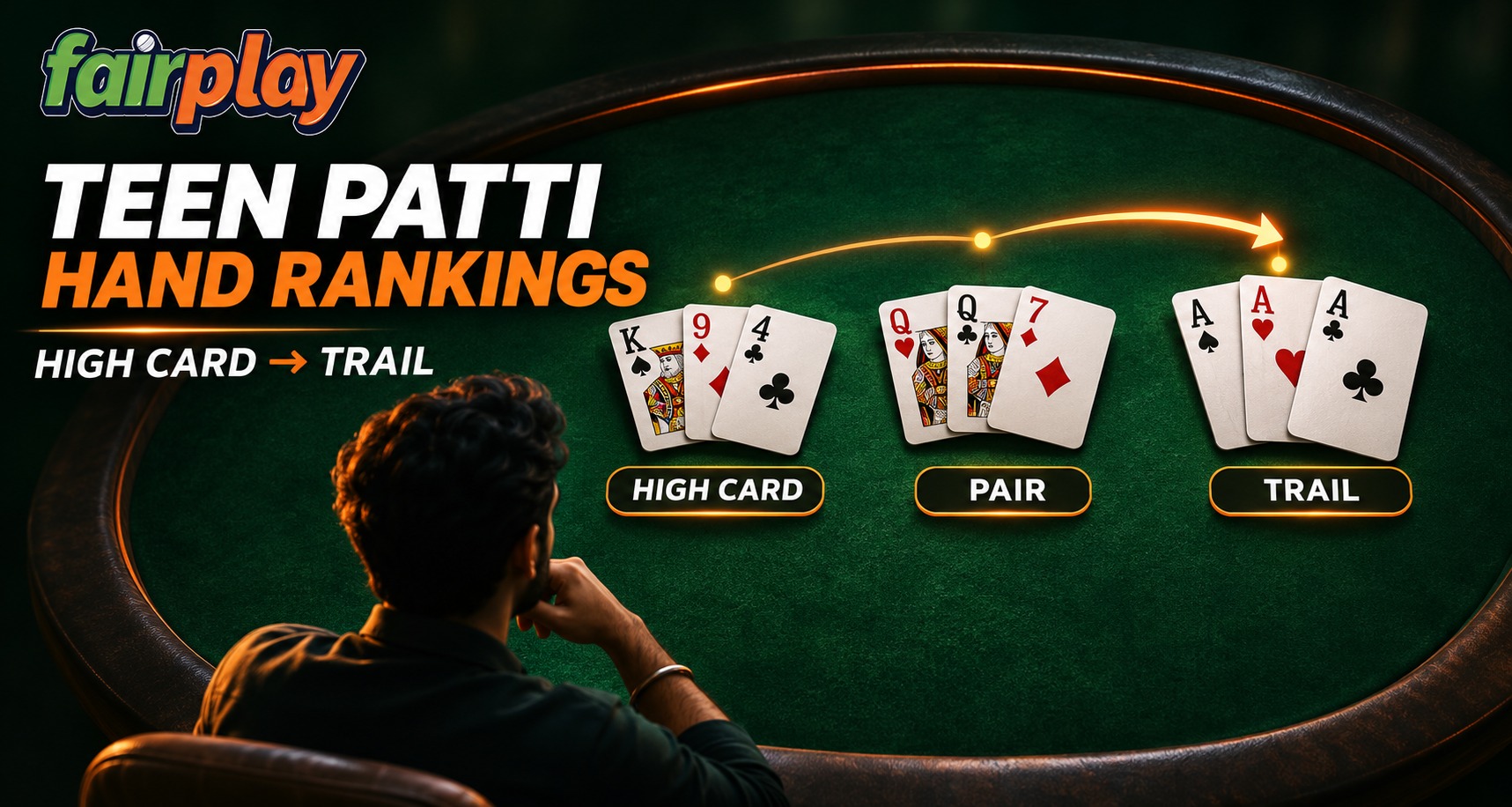
Teen Patti hands are ranked by category before individual card values are compared. For readers using the Fairplay app, the usual order from weakest to strongest is High Card, Pair, Colour, Sequence, Pure Sequence and Trail.
This explanation covers classic three-card Teen Patti without jokers; individual variants and table rules can introduce exceptions.
Teen Patti Rankings at a Glance
| Weakest to strongest | What makes the hand | Example |
|---|---|---|
| High Card | No pair, sequence or same-suit combination | A♠ J♥ 8♣ |
| Pair | Two cards with the same rank | Q♠ Q♥ 5♦ |
| Colour | Three cards of one suit, not consecutive | K♥ 9♥ 4♥ |
| Sequence | Three consecutive ranks, not all one suit | 7♣ 8♦ 9♠ |
| Pure Sequence | Three consecutive ranks of one suit | 7♠ 8♠ 9♠ |
| Trail | Three cards with the same rank | K♠ K♥ K♦ |
The category comes first. A Pair of twos beats an ace-high hand without a stronger combination.
Understanding Each Hand From High Card Upwards
High Card
A High Card hand does not qualify for another category. Compare the highest card first, then the second-highest, then the third if necessary.
For example, A-K-9 beats A-Q-J when both hands have mixed suits and no other combination. The aces match, so the king decides the comparison.
Pair
A Pair contains two matching ranks and one different card. Compare the pairs before considering the remaining card, called the kicker.
Q-Q-3 beats J-J-A because queens outrank jacks. If both hands contain queens, Q-Q-9 beats Q-Q-7 through the kicker.
Colour
Colour means three cards belonging to the same suit. Three red cards do not qualify unless they are all hearts or all diamonds.
When comparing two Colours, compare their highest cards, then the next cards as needed. A-J-6 of hearts beats A-10-9 of clubs because the jack outranks the ten after the aces match.
Sequence
A Sequence contains three consecutive ranks that are not all the same suit. It is also called a run.
A nine-high Sequence such as 7-8-9 beats a seven-high Sequence such as 5-6-7. Under the classic order, even a low Sequence beats a Colour.
Pure Sequence
A Pure Sequence combines consecutive ranks with one matching suit. It is sometimes called a straight flush.
For example, 5♥-6♥-7♥ beats a mixed-suit 9-10-J because Pure Sequence is the higher category. Compare category first, rather than being distracted by larger individual cards.
Trail
A Trail, also called a trio or set, contains three matching ranks. Three aces are the strongest classic Trail, while three twos are the weakest.
Even the lowest Trail beats a Pure Sequence under the classic ranking system.
Ace Sequences Need a Table-Specific Check
A-K-Q and A-2-3 are commonly recognised sequences, but their relative position is not universal. Published versions use different ace-sequence orders.
Do not assume that an ace always works like it does in another card game. K-A-2 is not an ordinary valid Sequence.
Readers exploring Fairplay in a browser should check the selected game’s ranking information before deciding whether an ace sequence outranks another run. This is especially useful when moving between providers or variants.
A Simple Method for Comparing Hands
Use this order when practising with sample cards:
- Identify each category. Check matching ranks, consecutive ranks and suits.
- Compare category strength. Trail outranks Pure Sequence in the classic order.
- Compare ranks within the category. For Pairs, compare the pair before the kicker.
- Apply published exception rules. Confirm ace ordering, joker use and exact-tie treatment.
Suits do not automatically provide a higher rank merely because one hand contains spades. If the card ranks are otherwise identical, consult the table’s tie procedure rather than assuming the pot must be split.
For Fairplay app readers, practising a few comparisons without stakes is a useful next step.
Read More : Best IPL Betting Markets Explained for Beginners (2026 Guide)
Conclusion
Remember the ascending order: High Card, Pair, Colour, Sequence, Pure Sequence and Trail. Compare the category first, then the relevant ranks. Check ace sequences and variant rules separately, and you can interpret most ordinary three-card hands clearly.
FAQs
What is the strongest classic Teen Patti hand?
Three aces: the highest Trail.
Does a Colour beat a Sequence?
No. A Sequence ranks above Colour in classic Teen Patti.
Does Colour mean three red or three black cards?
No. All three cards must share one suit.
What decides between equal Pairs?
Compare the remaining card after confirming that the pairs have the same rank.
Is A-2-3 always the highest Sequence?
No. Its position varies, so check the game’s published ranking order.